Neural Representation and Latent Space Synthesis of
Bidirectional Texture Functions
Mengqi (Mandy) Xia*1,
Yuzhen Zhang*1,
Yutong Yi1,
Sumit Chaturvedi1,
Emilie Nogué2, Yiwei Hu3, Julie Dorsey1, Wenzel Jakob4
Emilie Nogué2, Yiwei Hu3, Julie Dorsey1, Wenzel Jakob4
1Yale University, 2Imperial College London, 3Adobe Reserach, 4EPFL, *Equal Contribution
Eurographics Symposium on Rendering (EGSR) 2026
Abstract
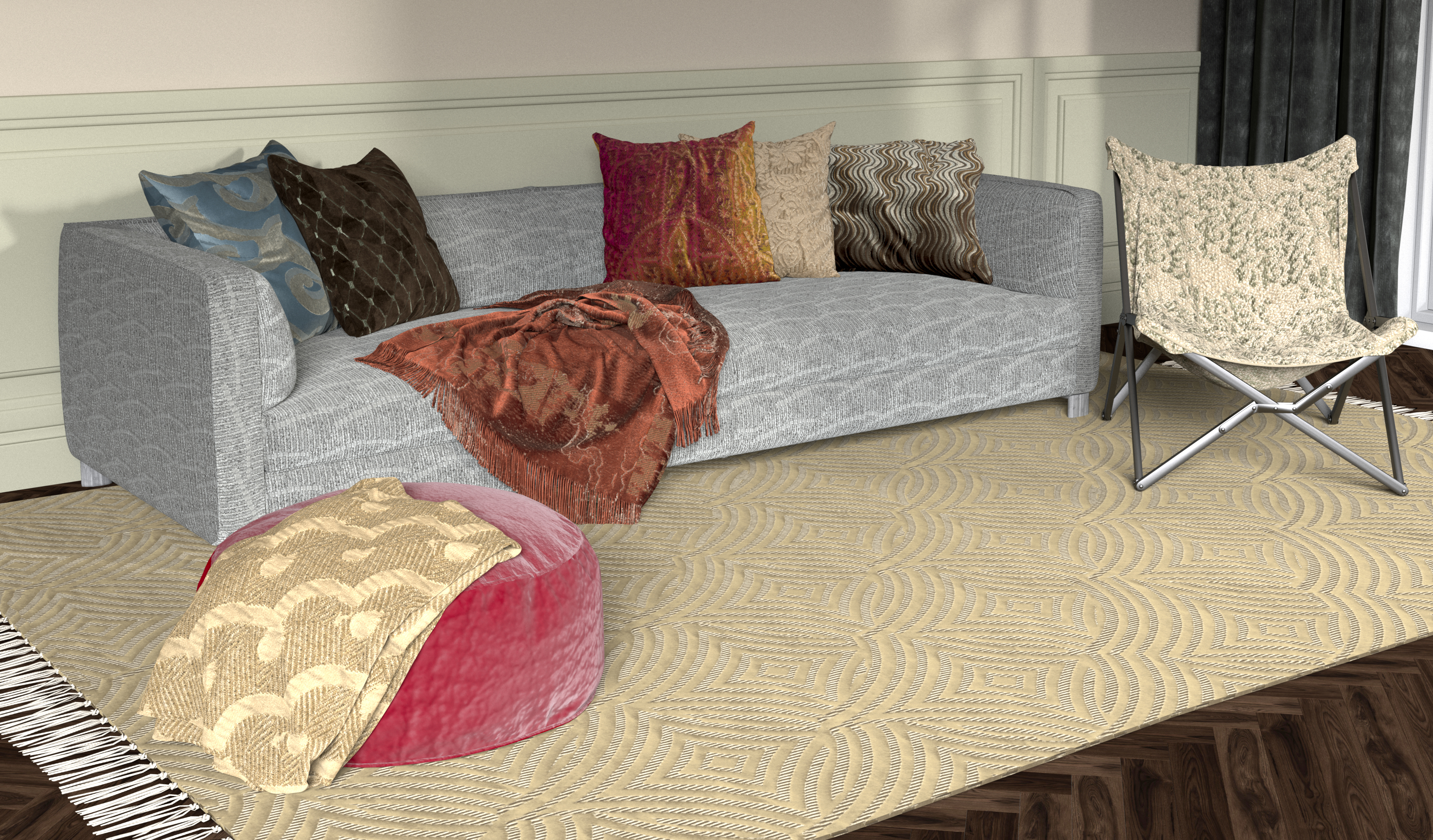
Real materials exhibit mesoscale structure, spatial variation, and view dependent scattering that are poorly captured by existing parametric reflectance models. Bidirectional Texture Functions (BTFs) can reproduce these effects, but they are difficult to represent compactly and extend beyond the captured area. We present a unified approach for high-fidelity BTF acquisition, neural representation, and large-scale synthesis. We introduce a new BTF dataset of complex real-world materials with rich spatial variation and angular effects. To compactly represent this data, we propose an improved per-material neural BTF model that combines multi-level neural textures with a flexible 2D neural offset, significantly improving reconstruction accuracy over prior neural and parametric methods. To extend BTFs beyond the captured region, we perform synthesis directly in the learned latent space of the neural BTF representation. Our hybrid synthesis framework leverages a latent diffusion prior to refine latent Wang Tiles, producing high-resolution, tileable and high-fidelity material assets for rendering and design applications.
Video
Acknowledgement
This project has received funding from the European Research Council (ERC) under the European Union’s Horizon 2020 research and innovation programme (grant agreement No. 948846) and from the European Union’s Horizon 2020 research and innovation programme under the Marie Skłodowska-Curie grant agreement No. 956585.